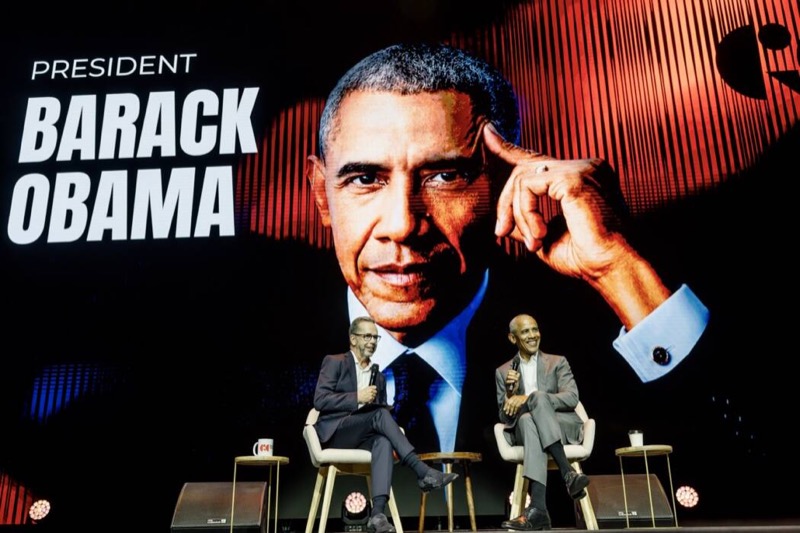
I almost did not go. I was going alone, which I dislike at this kind of event, and the warnings about security checks and early arrivals had me half convinced to stay home and spend a slow Saturday with my family. In hindsight, that hesitation was a first hint of what I would bring back from Lisbon: some slowness is worth protecting.
I am glad I went. The Game Changers Forum started on time and ended on time, which is rare enough in Portugal to count as a first impression. Then came a full afternoon of people talking about speed: faster companies, faster decisions, a faster State, and AI moving faster than anything before it.
Speed matters, and I left convinced we need more of it. But what stayed with me was a sharper idea: we are often slow in the wrong places, and at risk of becoming fast in the places where slowness is the point.
A country that fails slowly
Almost every panel circled the same diagnosis. Portugal has talent, ideas and people who build world-class companies. Ricardo Mendes, founder of Tekever, put the problem in one sentence: “We act very slowly, and we even fail very slowly. We have to fail faster.”
Barack Obama was not talking about Portugal, but I suspect many in the room heard it that way, as I did. When it takes fifty meetings to do something simple while housing keeps getting more expensive, he said, “at the end of the day, people want a house”. People do not care about rules, meetings or processes. They want the problems they feel in their lives addressed, and when institutions do not deliver, people lose patience with them.
I left more convinced that the potential in Portugal is real. What holds it back is rarely a lack of ideas. It is habits and structures that take away agility: procedures that create no value, decisions that wait for the next meeting, a fear of failing in public that makes failure slow instead of cheap.
Carlos Moreira da Silva was blunter: part of this is about managers and entrepreneurs, not only about the government. I agree, with one caution: it is easy to nod along while picturing other managers.
So how much of our slowness belongs to the State, and how much is a habit each of us repeats every day?
Friction on purpose
And yet the line from Obama I keep returning to pointed the other way: “Democracy is not efficient. But I believe it’s really important for everybody to feel as if they have a say and play a part in our society.”
He said something similar about AI. The tendency will be to take shortcuts, even to end a relationship with the help of a chatbot. Each shortcut like that takes away a chance to feel something and to learn responsibility. Convenience and efficiency are what we are sold all the time, and his advice went against the current: “Create a little more friction. It doesn’t have to be efficient all the time or fast all the time.”
At first this sounds like a contradiction: the same afternoon that told Portugal to move faster also told us not to make everything efficient. I do not think it really is. Obama was not defending bureaucracy, and I would not want anyone to read him that way. What the day showed me is that there are two very different kinds of slow.
One protects something: judgment, care, empathy, someone’s right to be heard, a decision that requires a night’s sleep. The other exists because nobody owns the problem, or because we are used to it. The first deserves to be defended. The second is just delay with a good excuse.
The test I took home is simple. When something is slow, ask what the delay is protecting. If there is a good answer, keep it. If there is none, it is waste.
The slow work of leadership
Leadership turned out to be the clearest example of slowness worth protecting.
Carlos Moedas opened the day with a story. At the 2010 NATO summit in Lisbon, Obama walked past a group of Portuguese journalists and called over his aide David Simas, the son of Portuguese immigrants, to say hi to his “family”. The gesture took 30 seconds, yet sixteen years later, thousands of people at the MEO Arena were reflecting on it. ‘That’s leadership,’ Moedas said. The gesture was quick. The habit behind it, of noticing the people around you, is not something you build in 30 seconds.
Later, Filipe de Botton said that a good leader is one who creates leaders beneath them, and that he is surprised by how often people say “I” when they talk about an organisation. Moedas made the same point from the other side: insecure leaders do not like making room for others. And Obama recalled how, in his first weeks as president, he asked a young staffer at the edge of the room what they thought. Junior staff rarely speak in meetings with the President, but they are often the ones doing the actual work, and they know things their bosses do not.
These are all slow things. They do not scale, there is no dashboard for them, and nobody gets promoted in a quarter for giving up the stage. Developing someone takes years. Making room for others costs you something today. And yet it was exactly what every leader on that stage described as the thing that lasts.
I wrote before about empathy as a leadership strength. This is the next step: not only feeling for people, but making room for them.
The mirror
Which brings me back to the question I left open: how much of our slowness belongs to the State, and how much belongs to us?
A lot of what was said about leadership made sense to me, not as news but as things I had already thought. I recognised some of my own convictions on that stage, and with that came a fair question: am I practising them as deliberately as I believe in them?
Making room for others, building the people around me, involving the person at the edge of the room: these are habits, and habits need attention, especially when a calendar full of urgent things keeps pushing them aside. I came back home wanting to be more intentional about them, in the work I do and with the people I work with.
When I apply the same test to myself, the answer is uncomfortable. The delay in those habits protects nothing. It is the second kind of slow, the kind that exists because I am used to it.
I do not have a neat conclusion, only a place to start looking. The slowness worth worrying about is not always in the State or in organisations. Sometimes it is in the distance between what I say I value and what I do on an ordinary Tuesday.